
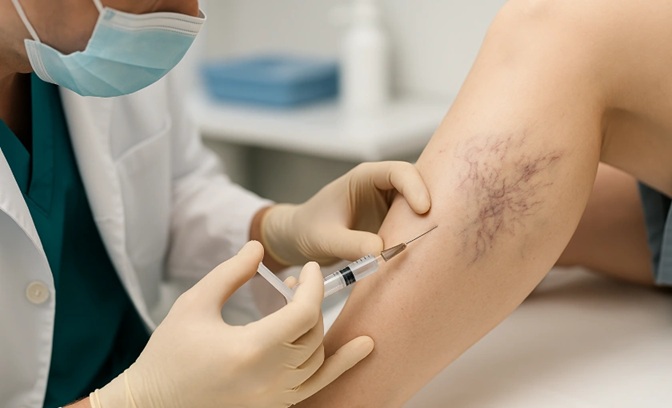

Thread veins on the legs have a frustrating quality. They are usually harmless, but they seldom disappear on their own and often become more noticeable over time, spreading as fine red, blue, or purple lines across the thighs, calves, or ankles. Creams cannot reach them because the problem is inside a blood vessel. Treating them means acting on the vessel itself, and that is the principle behind Sclerotherapy, a technique that has been refined over many decades into a way of removing unwanted surface veins.
What Happens Inside the Vessel
The treatment relies on a substance called a sclerosant, delivered into the target vein through a very fine needle. Rather than destroying the vein with heat or removing it physically, the sclerosant works by irritating the delicate inner lining of the vessel wall. That irritation provokes a controlled reaction. The walls become inflamed, swell, and stick together, which seals the vein shut so that blood can no longer flow through it.
Once a superficial thread vein is sealed, the blood that used to pass through it simply reroutes into deeper, healthier vessels nearby, which are perfectly capable of carrying that flow. The circulation in the leg is not compromised, because these fine surface veins contribute very little to the overall return of blood toward the heart. What has been closed was never essential to begin with.
Why The Vein Disappears Gradually
A sealed vein does not vanish at once. Over the weeks and months that follow, the body treats the closed vessel as redundant tissue and begins to break it down, absorbing it slowly until it is no longer visible beneath the skin. This is why patience is part of the process. Smaller spider veins may fade within a few weeks, while larger or more established vessels can take several months to clear completely.
There is a detail worth anticipating. A treated vein can sometimes look worse before it looks better, appearing darker or more prominent during the early healing phase. This is a normal stage of the reabsorption process, and it usually resolves as the body continues its work.
The Role of Aftercare and Careful Assessment
What a patient does afterward affects the result. Gentle walking is normally encouraged because movement keeps blood circulating and supports the healing vessels, while strenuous exercise, hot baths, and saunas are usually avoided for a period. Compression stockings often form part of the plan, applying steady pressure that helps the treated walls stay closed and can reduce swelling and discomfort as the leg settles.
Not every visible vein is suited to this method, which is why assessment is essential. Very fine red vessels sometimes respond better to laser, facial veins are generally handled by different techniques altogether, and large, bulging, or painful varicose veins may point to an underlying circulation issue that needs proper medical investigation before any cosmetic treatment. Belle Clinic in London approaches this as an individual evaluation, examining the size, colour, and pattern of the veins before deciding whether the technique is appropriate.
The treatment closes vessels the leg does not need, hands their work to healthier ones, and lets the body clear away what remains. With realistic expectations about the gradual timeline and a willingness to follow the aftercare, it offers a dependable route to clearer, more comfortable-looking legs.
